

At the mere hearing of the name of Syra, many people think of the taste and aroma of her traditional sweets, the well-known ones “loucoum delights”.
To others who have known her more, Syra comes to their minds as the First Commercial Port and the first Industrial Center of Free Greece and to others, who meet her for the first time in front of them, is none other than the first stop, the first port where the ship arrives at the route to reach Mykonos.
Among the many firsts which Syra counts, he certainly brags about its rich and impressive Carnival whose traces have long been lost deep in time.
Customs which they got mixed up in the duration of the two great different periods of its history, the first one before the Greek Revolution in the only place inhabited the at this time, Chora (Town) – today’s Apano Syra ( Upper Town) – and the second one after the arrival of the greeck refugees from the eastern islands of the Aegean, being settled in the space of the natural port located in the east of the island, the today’s Hermoupolis.
These new settlers, inside in their luggage, except their household, rich or poor, carrying in them an uncertain and pale hope of survival, they also brought their own songs and their own stories but mainly their own customs and traditions in order to remind them of the place they left forever, and offering them as a gift to the new land which accepted them, they mixed them with the local ‘s ones, creating a feast from colors and music which accompanied them for many years in all forms of their common cultural life.
So, all this diversity is what gaved this special character of the Syros Carnival.
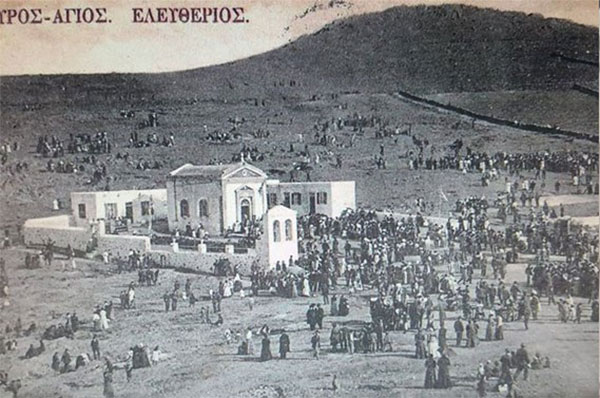
During the period when the indigenous of Syra’s island lived only on Apano Syra ‘s hill, the life was quite difficult considering that in the course of these centuries the inhabitants lived with many difficulties receiving multiple blows from the consecutive Turkish-Venetians wars, of pirate raids, of pestilence and death epidemics.
Confined to the castle, insecure and afraid enough, employed exclusively with agricultural cultivation, fishing and limited shipping activity , without special education until the 17th century, additionally nurtured and committed to the teachings of the strict Catholic Faith, they didn’t manage to create that framework to show any large imagination during the celebration of Carnival.
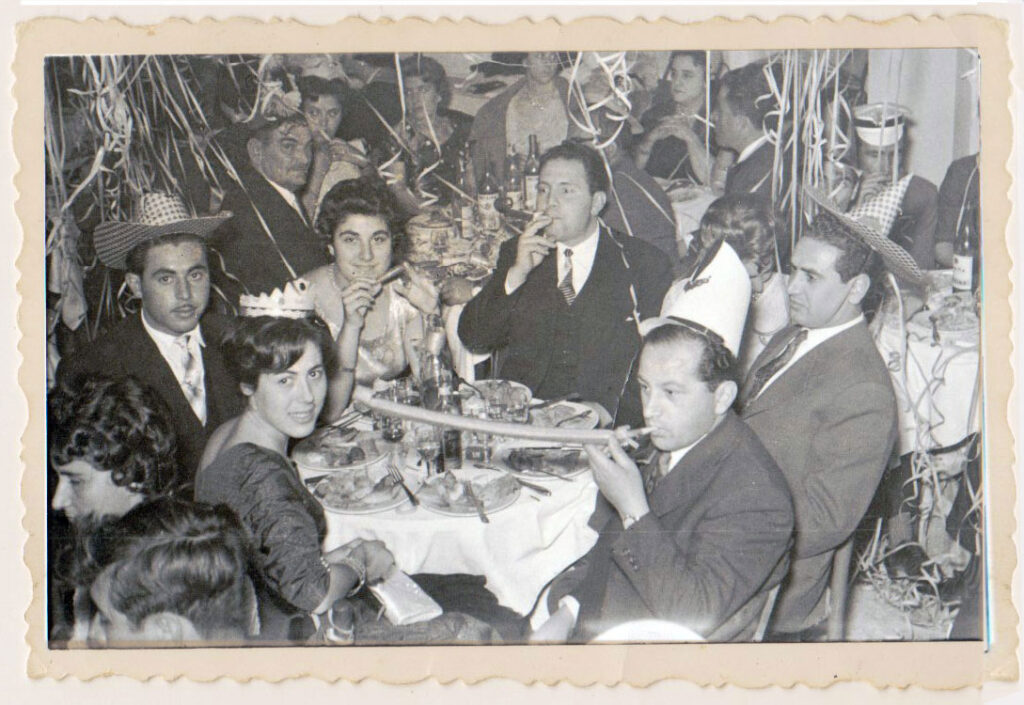
However, the Carnival Season, with feasts, food , music , songs and dances which they had as their crown the “ballo” and the “Syrto”, dancing accompaniment of the sounds of the Cainda (or otherwise Jambunas), of Tambourine and of Trambouka, held well.
The question that was heard days before on the Last Day of the Carnival was: “Where will we go to carnivalize”. They gathered in houses and feasted putting” refene: , which means , everyone he brought food or wine to share it with all the company.
Some of them were ” masquared” that meant that they were dressed up with mprovised masquerades with old and tattered clothes or women’s ones because the masquerades were usually men, wearing also masks made of paper, (I remember when I was a little child, my grandfather used to make masks like this from newspaper by cutting them at the points for the eyes and nose… I ‘m sure that his own grandfather would have taught him…).
Disguise ideas were taken from their daily life but also from the spectacles of the era… Men who were being dressed as gypsies with frilly clothes, as bears that were dancing with the bear-bearer to play tubi or tambourine, as brides and grooms or others dressed in animal sheepskin wearing horns on the head. The masked men were holding in their hands some objects that were causing loud noise like rattles, sheep bells or tubis. During this period the housewives were making various kinds of sweets whom generously were offering to the masquerades who roamed the alleys and the squares last Carnival Day teasing the world and saying funny songs with disguises messages.
For the Catholic inhabitants ofApano Syras ( Upper Syra,) the last day of the Carnival was not on Shrove Monday but on Shrove Tuesday, because on this day is that they consume and the last fatty food. From Wednesday of Lent (or Ash Wednesday) the season of fasting officially begins and the temperance that must be accompanied by prayer and the ” charities” (good deeds). On Shrove Tuesday there was a big feast with dances in which the whole community was being gathered in the central square, to say goodbye to the Carnival.
In the other hand, in Herrmoupolis the things were very different…the reason was obvious. The two very large classes which were created from the very first years of its creation were characterizing the city’s social profile. The working class, with its humble origins , the lack of basic resources as well as access to education standing opposite the other one, the brilliant and the strong, the urban, or the bourgeois one I would say, class which, had access and influenced exclusively by the pioneer West.
The common people of daily wage, during these days of Carnival, were gathering at houses or yards or in the best case, in some humble tavern or coffee places , not exactly as it comes today to our mind…
Cheap wine and fried snacks (!!) in the best case, with travelling musicians playing elementary songs with cainda and tubi or some “little hand organ” (like barrel organ).
As the years go by and so does the economy of the island flourishes, the stratification is also changing and the society evolves. Therefore, things also change in the Carnival celebration .

We learn that in 1890 a committee called Comitatohad been founded, for the Carnival conduct and the prize for the best disguise in Ermoupolis. It had even set a cash prize for the winners of the competition…
1st prize drachmas 250.
2nd prize drachmas 150.
3rd prize drachmas 100.
4th prize drachmas 70.
5th prize drachmas 50.
6th prize drachmas 50.
In the same year, during the competition, fifteen days later its recommendation, the following “deplorable incident” took place:
Some philology graduate, impersonating the prime minister of the country in that time, Charilaos Trikoupis, astride to a donkey, which was followed by a few more donkeys without a saddle, on whom the inscription “You are from 76” (meaning the number of its MPs then prime minister) was written, with others also inscriptions such as “Monopolies”, “Taxes and taxes again”, “Loans and loans again” – finally, no matter how many years pass, the same things happen !! – having succeeded against much the resemblance in its face and its appearance and imitating with terrible success his moves, he took part In the competition.
The whole world, regardless of politics faction as well as the Committee itself approved him with applause and cheers, but the Local Police Authority, the Commander of the Squadron, forbade him to parade in front of the committee because he insulted prime minister’s face.
The crowd then went wild with cheering he prepared to… “devour that impertinent one as well and the public power, under whose patronage all these took place, walking sticks and seats from around coffee shops rose up, a terrible rupture was about to follow…”. (publication Syrian newspaper of this period of events).
The solution to the incident was given by two judicial officers, who, from the leader of the Club had witnessed and heard everything and with reason and prudence the spirits finally calmed down. This disguise, although admittedly it was the most successful of all participated, due to the events hadn’t been awarded from the committee’s money, although he desired it fervently, but from an impromptu fundraiser between those present within two hours, totaling 510 drachmas.
There are also many others publications that, from time to time, they comment on the events and the happenings in Syros Carnival. In 1894 we read a commentary on some newspaper: Hermoupolis… “entertained brilliantly in all these classes. There were everywhere the chants pervading the air and erratic steps hitting the ground. The manes (monotone oriental song), the songs were followed by the dances and the “lancier” ( kind of dance), and the organanaki ( little barrel organ) duly replaces the clavichord. Fortunately, inspite all their cheerfulness of the citizens which escaped from all the houses up to the wine shops, nothing deviant, nor criminal happened, thanks to the strict police vigilance and the measures which had been taken”.

So, this is what the testimonies give us as the image of how the common world were celebrating the Carnival Feasts…
From the newspapers publications we are also informed about how the affluent class of Syra was honoring the Carnival: The glamorous class of the bourgeois in the other hand, had a different way to celebrate the Carnival, a completely foreign one, an Occidental one and by far… “modern” in a way, which was beating exactly the same as that in the heart of every single European capital.
They giving up little by little, as time was going by over the years, their roots and their traditions in combination withtheir ever-increasing wealth and borrowing new ideas, changed their habits , as a natural consequence of all those. Mansions with large banquet halls where European music was playing, expensive wines were flowing and imported tempting gastronomic delights were being offered, with halls adorned with fresh flowers, with statues, elaborate decorations and works of art were welcoming well-dressed gentlemen accompanied by elegant ladies with rich dresses from the best European ateliers, with splendor and refinement, with silk, lace and velvet, wearing shiny jewels and expensive perfumes.
Waltz and foxtrot, the favorite dances for the masque dancing couples, enjoying the Carnival mood, drinking champagne in crystal glasses and maybe once their look, by chance, …maybe…, sometimes …, was falling out of the window with the heavy velvets curtains and fleetingly could see there, in the central square, the gathered crowd of simple people who celebrated the Carnival in his own way, with folksy instruments and barrel organs, wearing simple masquerades, people who were partying with laughters, with dances and songs and who enjoyed so much to participate in the dance of the Zeimbekia, the only authentical carnival custom of Syra.
0 Thoughts on Carnival in Old Syra – Α magical time travel.