

The common people in Syra was having lot of fun with the custom of Zemibekia…
From Markos Vamvakaris (the most popular musician rabbet born in Syra) autobiography we learn the following: Only me from all my family I was dancing with the group of the zeibekia. I do not know if now they still perform in Syra, anyway, they came from Syra. Everyone was participating at its own quarter with his captain, and everything was ok with all of them. We had to show respect to our captain, to obey him listening on what he was telling us and to learn the dance. He was teaching us. We were dancing and the whole world was proud of us. What would you want to see, the masquerades or these things that I am telling you now, all this silk. Nice things. Such a fantastic short furs, tuzlukia (protective cover that covers the shin from the top of the shoe to the knee), shoes, flowers, so many flowers! I don’t know how the Zeimbekia started. Nevertheless they began in Syra. Either in Apano Chora (Upper Town) or in Kato (the Down Town Hermoupolis), I don’t know.”
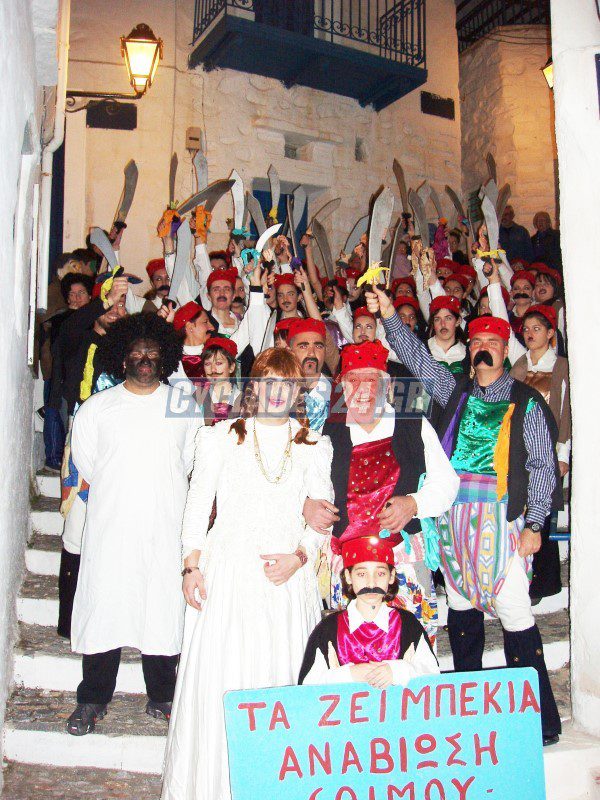
Zeibekia was an event which, from only the origin of its name refers us to Asia Minor and more specifically in Kydonies, the today’s Ayvali, since the Rural Guard Corps was called like this which were in fact permanently armed night and day. If we take into account that many of new residents who arrived at that period in Syra and in which the first years of their stay initially lived on the outskirts of the already existing city and later in the surrounding areas (Vrontado, Kaminia, Neapoli, Xirokampos), then we can say that this custom really started from Ano Syra and its surrounding neighborhoods, since the participants were, many of them, Greeks who came from those regions of Asia Minor, bringing their memories from the places they left, reproducing and parodying them in the Carnival season.
During this performance, an old war dance was revived in which male couples were dancing, having as its subject the kidnapping of the Bride, the First Captains wife. The dancers were having at their side a hanging armed case and during the dance they were grabbing with great rapidity the short knife and they were writing in the air spectacular movements or were planning impressive dancing gestures, in attempt to stab each other. They were taking steps forward, steps back for defense and they were spinning. Those who were watching the dance they were clapping enthusiastically. The suit of the dancers was according to others a foustanela (a kind of men’s kilt), and some others are talking about colored trousers, with white shirt and silk bodice full of sequins, which entered in front of the chest, waistcoat with sleeves thrown back in their back. Some people described that the dancers were wearing on their heads a red cap with sequins, they were having gaiters with small bells (kiuzulukia) and around the waist they were wearing a colored belt while around the neck they were wearing a silk scarf and various other colored ones passed on their belt, on their chest but also on the handles of the weapons and of their knives.
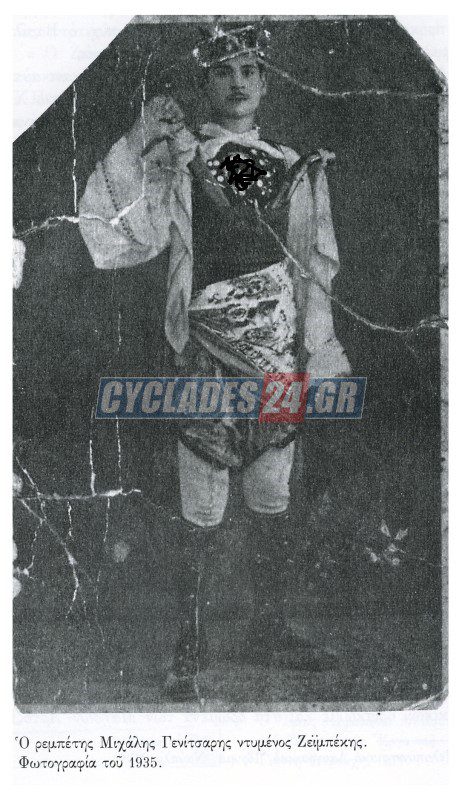
From information collected by Mr. Solaris Nikos, beloved teacher of dance of the Syra, he says the following:
«The above dance was being danced on the Carnival from a group of 20-40 people. There was the first Captain, the second captain and the third captain who they called him Mustafa. It existed the archichanumissa (man dressed as a Bride), one or two black face men, a hunter, the captains guard and the zeimbekia (the rest of dancers dressed with their costumes). As a First captain was being appointed the best dancer who was undertaking to learn the dances in everyone who was making up the team. Before this event the masquerades in small groups were going around the Apano Choras neighborhood spreading laughter. From Sunday morning the Zeimbekia were beginning to be poured into the straits of Ano Syra with songs and dances. Before the start of this event, the first Captain was giving an order: “I am commanding you to pay close attention when we go to the Piazza, and dance well. Once the dance begins take care of your weapons not to become a fuss.”
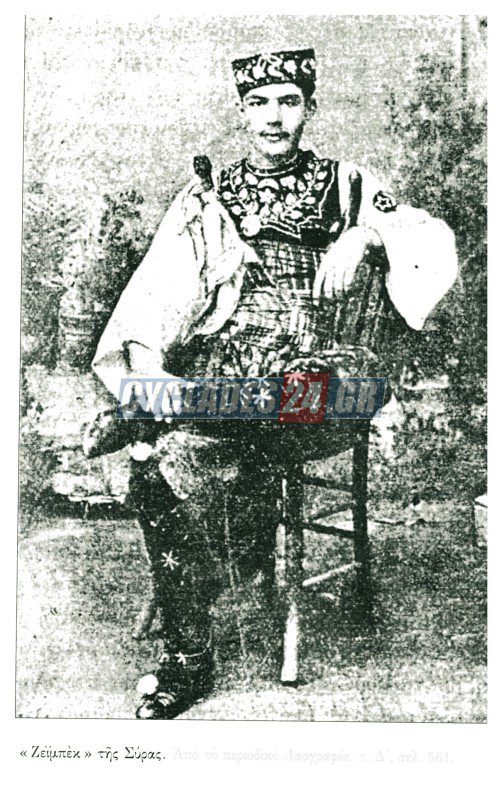
Then, the second Captain was adding:
-“Order from the Captain, be careful, don’t miss the kirvani (pouch) with the golden coins”. All the Zeimbekia were answering:”We don’t give up our arms we pour our blood”. The Zeimbekia were dancing danced in a circle that a black faced man had carved with his sword. They were dancing Hasapiko, Hasaposerviko and Zeimbekiko. To some point of the dance, one black faced man finds the opportunity to kiss the Bride and to abduct her. This is perceived by the Captain and sends the hunter to catch him. The Captain next condemns the Arab for what he did to death by fire. Other groups were coming down from the top of the Hill in the center of the city (Hermoupolis) and they were continuing there the festival in a happy atmosphere. The Zeimbekias were being accompanied by musical instruments such as kindelli (bouzouki with 2 strings), thug (clay tubercle with dog skin) and tambourine.
At the dances which were following in Piazza (or Danelaki), the central point of Apano Chora, there were a lot of dancing in pairs of dancers or in one at a time. All the dances were being done in a frenzy atmosphere.
I would like to thank Mr. Solaris Giorgos for giving me the authorization to use optical material from the photographic collection of Cyclades24.gr, digital journalistic channel of Syra.
0 Thoughts on Carnival in Old Syra – The custom of Zemibekia